do a synopsis and then dig in for the remainder of the article?
somehow I don't think so.
Tuesday, June 22, 2010
Tuesday, July 01, 2008
A dessert from the U.K., perfect for summer
Summer Days and Tasty Treats
“Eton Mess” isn’t in our game GourmetSmarts but it could have been a contender. The story goes that is was invented at Eton, a famous school, in Britain, when a dog sat on a picnic basket, single handedly creating the first version of the dessert. It is now served every June 4th at Eton's annual prize giving ceremon
Summer has finally arrived in San Francisco, with a set of heat waves that have occasionally allowed us to sit outside at night without a down jacket. So its time for some delicious summer treats. I recently visited my brother in London, and his daughters served me a delicious British twist on strawberry shortcake, called Eton Mess. It’s a perfect, no hassle, summer dessert. And if you want to feel like you're at Wimbledon, open up a bottle of bubbly to go with it!
Eton Mess recipe
- Meringues – you can make your own or just buy meringues at the store
- Heavy cream
- Strawberries
Break up the meringues into pieces about a half-inch long, in a large bowl
Whip the heavy cream so its thick. Do not add sugar.
Fold the whipped cream and strawberries into the meringues and voila! The mix of the sweet and crunchy meringue with the unsweetened, creamy cream and the juicy strawberries in every bite gets everyone asking for more.“Eton Mess” isn’t in our game GourmetSmarts but it could have been a contender. The story goes that is was invented at Eton, a famous school, in Britain, when a dog sat on a picnic basket, single handedly creating the first version of the dessert. It is now served every June 4th at Eton's annual prize giving ceremon


Wednesday, December 19, 2007
SmartsCo featured in The Wall Street Journal!
We are delighted that the Wall Street Journal thinks SmartsCo is interesting enough to feature on page B1! The journalist interviewed Julie and focused on the Make Mine a Million $ Business Award from Count Me In and OPEN from American Express.
Wednesday, September 19, 2007
Wine and Dogs...the perfect pair
Wine and Dogs...the perfect pairDon’t get me wrong, I’m not suggesting you give your pooch some Pinot (in fact wine is supposed to be bad for dogs). But ever since we released DogSmarts , I’ve been noticing how dogs and wine seem to go so well together. Today I saw an article in Wine Enthusiast that describes a pilot program to have dogs sniff out vineyard pests. Some Napa and Sonoma wineries are training the dogs to sniff out the vine mealybug. The dogs can find the pests before the bugs are a huge problem in the vineyards, allowing wineries to catch the pest early and use less of those nasty pesticides. As for other dog and wine connections, here are jut a few: Wine & Noses. Canine Companions for Independence hosts this annual fund raiser in New Jersey. CCI trains dogs to assist people with disabilities and we donate 3% of proceeds from DogSmarts sales to CCI.
| ||
| Close | ||
Friday, September 14, 2007
Dog Fights Leg
A good laugh
While normally I'm not a huge fan of the America's Funniest Home Videos, genre, this one is a pretty funny dog scene.
Saturday, September 08, 2007
Five Paris Discoveries
Five Paris Pleasures
I was recently in Paris and had so many delicious, relaxing, and enjoyable experiences, I thought I’d share them with anyone who’s planning an upcoming trip. Here are 5 of my favorites (good additions to all of the suggestions we’ve compiled in our ParisSmarts game).
1) Bicycles rule. Paris has embraced bicycles as a green way to lessen traffic congestion, and they've gone at it wit
It’s a bit difficult for me to restrain my enthusiasm for Vélib. It’s sort of a ZipCar for bikes, with one great difference: you can return the bike to anywhere there’s Vélib parking...no need to go back to where you got it! Paris did this right (see what The New York Times has to say about it). Not that everyone loves them. We were in a cab that nearly ran over one Vélib -er.
One note: If you’re Canadian or American, bring your American Express (and we’re not just plugging Amex, which is a supporter of Count Me In). I tried using a Visa, but there’s a glitch in the system that they’re working on. So for now, the Vélib swipers accept European Visa/MC, but if you’re American or Canadian, they only accept American Express.
2) View fr
3) Falafel Heaven. For the tastiest falafel, go to L’As du Falafel, a busy falafel stand and restaurant on the rue des rosiers in the Marais. The falafel sandwiches are luscious: warm pita, falafel, fresh cabbage salad, fried eggplant, tomatoes, and tahini. As you approach from a block away, you’ll see people eating these big messy sandwiches with looks of extreme pleasure. The muffintop blog has a great descriptions and pictures that make me rather hungry. And David Liebowitz also loves it (he just wrote a book all about ice cream, so that’s a man I trust).
4) Tea for two. My friend Kimberly Charles is a Parisian Manqué and brought me some tea from Mariage Frères last year for my birthday. The fragrant black tea in muslin teabags felt like a little Parisian indulgence, so when I went to Paris I had to go to their store…which, it turns out, not only sells tea old school (they have hundreds of teas, which they scoop out from large, old tin canisters on wooden shelves), but also features a tea room, and a tea museum (!) that can be reached by ascending a curling rickety staircase.
5) Books and wine. Walk into La Belle Hortense, a little bookstore with a light blue sign, and you’ll discover books and wines by the glass in an unpretentious, neighborhood atmosphere. This
Wednesday, September 05, 2007
Champagne Naming
Is It Fair?
I was reading my beloved New Yorker this week and was struck by a one-page ad from the Champagne Region of France. In it they say "Masquerading as Champagne ... might be legal, but it isn't fair. There are many find sparkling wines, but only those originating in the chalky hills of Champagne, France can bear that region's name. A legal loophole allows some U.S. wines to masquerade as 'Champagne.'" Then they want you to demand accurate labeling.
Several wine regions have signed a "Joint Declaration to Protect Wine Place & Origin , " which essentially is aiied to educate consumers about the importance of location to winemaking. These signatories include: Napa Valley, Oregon, Washington, Walla Wala Valley, Champagne, Porto, Jerez, and now Paso Robles, Sonoma, Chianti Classico, Tokaj, and Victoria and Western Australia. 
So this brought up a discussion in the office regarding the "fairness" of people using the term "champagne" to describe sparkling wine. The folks at Xerox are thrilled that their name comes up everytime someone uses their name rather than "photo copy." Why do the folks of champagne spend so much time and money trying to prevent people from using the term champagne to for sparkling wine? I'd argue they would have better use of their time.
When we created our WinePassport: Bubbly , we took great pains to use the term Champagne correctly, however, the title often confuses people. I was at a party the other day and asked for some "bubbly". The waiter brought me sparking water. The fact is, "champagne" as a general term describing sparking wine is here to stay and it (as well as terms such as Port) help people know what they're going to taste.
The press release announcing this Joint Declaration say "Americans are more knowledgeable than ever before about wine and will not settle for anything less than authentic products." If you believe that, give them credit for knowing that a "California Champagne" is not from France. They should spend more time focusing on creating quality wines with strong marketing and branding, not fighting a naming battle they cannot win.
Thoughts?
Wednesday, August 29, 2007
Barking All the Way to the Bank
If DogSmarts Released After Mrs. Helmsey's Death
I don't want to speak ill of the dead, but it would have been nice had Leona Helmsey passed just a few months earlier - it would have been great fodder for a DogSmarts question. You gotta love the "Queen of Mean" - she causes juicy controversy all the way to the grave. Had she passed before we went to press, we would have had a question along the lines of:
How much money did Leona Helmsey leave to her beloved dog?
A ... $1 million
B ... $6 million
C ... $12 million
D ... $36 million
Answer: C ... $12 million
I'm not exactly sure what Mrs. Helmsey's Maltese named Trouble is going to do with the $12 million trust fund - I think even the most exclusive dog spas in the world are around $100 / day. Of course he could get some nice diamond collars and lots of kibble. And when Trouble goes to that great dog park in the sky, his remains will be buried next to Mrs. Helmsey in the family Mausoleum. Lucky pooch! Her human family did not fare as well: two of her grandchildren were cut out entirely and the other two received a mere $5 million with the stipulation that they visit their father's grave at least once a year.
Get Your Pooch in Print
You can look for that question in the future printing of DogSmarts, but for now we have lots of other fun ones. Speaking of the next print run, we're already thinking of going back to press early next year and need more photos for the cards. In the first edition we held a Get Your Pooch in Print competition in which we were looking for several dogs who were representative of their breed to be featured on the back of the cards. We had lots of great submissions and added a few other photos.
This time we want a photo on the back of each card, so we need more submissions. If you have an especially cute pooch, please send us a photo and release form. There are still a few more breeds that we're looking which are outlined on the release form so they'll get first dibs, but we'll consider other especially attractive pups.
A few tips when taking photos of your dog:
- get down to their level - taking a picture from above won't work
- try to get a side shot of their full body
- don't dress them up in costumes
- don't have other people or animals in the picture
- ensure there's plenty of light and a good contrast background
Another option is to hire a professional. Lori Chung www.thepetphotographer.com takes some fantastic photos of dogs. Her very cute Chihuahua-Dachshund Mix (Chiweenie) "Flash" is featured in our DogSmarts Companion Guide.
Tuesday, August 28, 2007
DogSmarts Debuts at CCI Fundraiser
Our latest game gets conversation started
Last weekend I was able to combine two of my favorite pleasures – dogs and wine – at the debut of DogSmarts at the annual Celebrity Chef fundraiser for Canine Companions for Independence. We spent a delightful evening up in Sonoma County, enjoying tasty food and wine surrounded by very cute dogs while we raised money for a great cause.
We raffled off copies of DogSmarts, WineParty , and WineSmarts with a fun quiz and placed DogSmarts cards at each place setting, which was a great way to get the conversation started at the table. I had always though our games can be used as great ice breakers at big dinners such as this, and it was great to see my theory proved correct at this dinner with people sharing cards and showing off who knew more.
I first got connected with CCI through my friends Tara & Dane (at right), who have raised several puppies for CCI. They were always so cute, and when we decided to do a DogSmarts game and start our charitable giving branch of SmartsCo, CCI was the natural choice. It was especially nice to have them be a local organization with lots of wine lovers (and WineSmarts fans) in house.
My first visit to the CCI campus included a graduation ceremony which was so amazing. These dogs are specifically bred to be service dogs and have the most amazing demeanors. They also go through a ton of training, about a year or so with a volunteer puppy raiser and then intensive training with the CCI staff for about six months to nine months. Finally, the dogs are introduced to their potential partner, and the two go through two weeks of training together. At the graduation, the new partners get to meet the puppy raisers over lunch and then everyone goes to a graduation ceremony.
It’s amazing to watch how these dogs can change people’s lives, be they hearing dogs, service dogs for people with physical disabilities, skilled companion dogs for children with developmental or emotional disabilities, or facilities dogs for rehabilitation professionals, caregivers or educators and utilize a dog to improve the mental, physical or emotional health of those in their care. Pretty neat stuff.
Once you’ve experienced CCI, it becomes an addictive organization to support through volunteer activities or through financial support. My friend Tara and Dane were such successful puppy raisers, that they now have a breeder dog—Mondo—he’s such a stud (and so sweet—I would want one of his progeny).
Monday, July 16, 2007
Indian Wine Tasting
An expedition for our palates...wines of India
A group of us got together recently to taste an array of 8 wines from India. This unusual tasting included 6 wines that had been shipped directly to us from India, through a friend of my father. The tasting came about when my father, who grew up in India, visited our office a few months ago and talked with our office mate and friend Kimberly Charles of Charles Communications about India and the growing wine industry there. Kimberly was intrigued, and the next thing we knew, a mysterious, tightly shut crate arrived for her.
Kimberly, whose business develops marketing and public relations campaigns for wine and spirit companies, made the occasion of the arrival of the Indian wines into a fun event, inviting some impressive palates to taste them: Scott H. the restaurant reviewer of San Francisco Magazine, Alder Yarrow of Vinography and Olga KatzNelson, who works with Kimberly and is known, along with Kimberly, for impressive, funny one-liners. The wonderful Meredith Arthur and Eric from CHOW came to film our tasting for a web video for their site.

A quick background on Indian wines that we all just learned: The major wine producing areas are in the state of Maharashtra, in the central western part of the country, inland from Mumbai, and further south near Bangalore, which is also home to lots of tech companies. There are about 38 wineries throughout the country and 36 of these are in Maharashtra. In the 1980s, winemaking began in earnest, with wineries importing French grapes to cultivate.
On to the wines. We tasted all the wines without food first, in pairs. Here’s a quick overview of our notes. If you’re interested in creating a Indian winetasting, visit the winery websites (links below), and send an email to the distributors to see where you can find these wines. They tend to cost between $16-$35).
Alder offered a helpful perspective on pairing Indian foods with wine: he noted that spices tend to accentuate alcohol in wine, especially when the spices have heat, so you might want to look for lighter-bodied, sweeter and more aromatic wines.
WHITE WINES
Grover Vineyards , Sauvignon Blanc, 2005, Nandi Hills
The winery is located in southern India, on the outskirts of Bangalore. Michel Rolland collaborated on this wine, and it is exported to the US, UK and Japan. The winery is partnered with the French champagne house Veuve Clicqot Ponsardin.
Comments: This is a “competent” wine; “I like it as is”, The wine has lots of acid, so might be good with certain kinds of food, “The wine tastes tired; I’d like to try a younger vintage.” In general, this group was impressed with the winemaking of this wine.
Sula Vineyards, Chenin Blanc, 2006, Nashik
Sula may be the most easy-to-find of these Indian wines. This winery is located in northern Maharashtra, 2000 feet above sea level.
Comments: really well made; I enjoy this, but it doesn’t taste like a typical Chenin Blanc; musky, peachy aroma, and a nice balance of sweetness and acid. I like it! (me); aromas of apple and caramel. Alder prefers his chenin blancs to have aromas of parchment paper, almost like an old library, and this wine doesn’t have that.
Chateau Indage, Chardonnay, 2005, Sahyadri Valley This winery is partnered with Piper HeidseickMe: Musky aromas and a finish of honey and butter, balances by acid. I’m not a fan of buttery, CA chardonnays, so I enjoyed the restraint of this one. But I was very much alone! Others gave it a thumbs down, except one person had this mixed comment: Tastes like the winemaker poured in a few drops of flavoring for oak, butter, fruit, and then mixed it up. BUT, I’d also like to drink the whole bottle with Indian food.
Grover Vineyards Shiraz Rose, 2006, Nandi Hills
Light, raspberry juice color. Olga may have had the best description of the flavor: Bollywood movie in a glass! It was sweet and, as Kimberly described it, had a candy apple aroma and may suffer from too much skin contact. Alder added that there is an acetone flavor at the finish, and Scott, a Rose fan, did not like this at all.

Grover Vineyards, la Reserve Red Wine, 2004, Nandi Hills
Grover Vineyards, la Reserve Red Wine, 2003, Nandi Hills
Satori, Merlt NV, Nashik
Chateau Indage, Cabernet Sauvignon, 2005, Sahyadri Valley
Generally, none of us loved these red wines, and to be honest, there were some much stronger negative feelings about these. Some of the descriptions included: acetone, artichoke, very simple, Band-Aid aroma (Kimbelry noted that it has an aroma of a horse covered in Band-Aids!), and with the final wine, we all seemed to find aromas of movie candy: mint chocolate, good and plenty, jelly beans, and more, but not in a good way (and I love candy!). Overall comments: stick with the Indian white wines, and explore those.
Thursday, October 26, 2006
Scarily Scintillating Halloween

A wine and candy tasting for your adult trick or treaters
Did you say candy and wine? If you get bored sitting around waiting for the cute kids to ring your doorbell this Halloween, how about hosting a Halloween-themed wine tasting party? This will be a huge hit for you friends and all the adult trick or treaters.
You’ll really impress your guests by pulling out your copy of WineParty and offering a wine game to the adults who visit your house on Halloween. When they arrive offer them a taste of the blinded wine and ask them to guess what kind of wine it is. If they guess correctly, they get a tasty treat, if not they get your most devilishly devised trick.
While many people think that wine and candy don’t mix, we disagree. Get all your favorite Halloween candies, and offer a selection of wines that might pair well with them. Here are some ghoulishly delicious combos*:
1) Reese’s Peanut Butter Cups and California Meritage

2) Sweet Tarts and Sauvignon Blanc
3) Candy corn and dry Riesling
4) Almond Joy and Syrah
5) Snickers and Cabernet Sauvignon
6) M&Ms and Zinfandel
7) 3 Muscateers and Malbec
8) Hershey’s Kisses and Merlot
9) Butterfinger and Chianti or Sangiovese
10) Hot Tamales and Pinot Grigio
11) Nestle Crunch and Dry Rose
*WARNING: some of these pairings might be a fright. You decide!
If you’re hoping for a bit more elegant of an evening, serve your adult guests a selection of quality dark chocolates paired with red wines, Madeira, Port, or even some ales or dark beers (Barley Wines are particularly delightful).
Friday, September 22, 2006
CocktailSmarts Preview
Getting Ready for CocktailSmarts
Preview & Recipe
 The final proofs for CocktailSmarts arrived today, and we couldn’t be more excited about our newest creation. I admit, historically I’ve shied away from making drinks at home (and for that matter drinking them when I’m out). But as we’ve developed this product, the whole art of the cocktail has become quite intriguing to me, and I’ve been trying out lots of fun concoctions both in and out. Over the next few months, we’ll share with you some fun cocktail recipes and facts, including a particularly yummy one this week.
Preview & Recipe
The final proofs for CocktailSmarts arrived today, and we couldn’t be more excited about our newest creation. I admit, historically I’ve shied away from making drinks at home (and for that matter drinking them when I’m out). But as we’ve developed this product, the whole art of the cocktail has become quite intriguing to me, and I’ve been trying out lots of fun concoctions both in and out. Over the next few months, we’ll share with you some fun cocktail recipes and facts, including a particularly yummy one this week.Like our other products, CocktailSmarts has the fascinating question and answer cards with a scorepad that you can play at your next cocktail party. And the Companion Guide is packed with tips and tricks about how to make drinks at home. This time we’re also including a dozen festive coasters with drink recipes and it comes in a fantastic tin that will make is an especially stylish addition to any home bar or coffee table.
We’re busy planning launch parties in New York and San Francisco later in the year, and if you haven’t already done so, sign up for our newsletter now.
We’ll be sending out information about these parties as we get closer to the date, and the guest list is sure to fill up fast. We’re curious about your favorite drinks and bartenders. If you have drinks, bars, or cool bartenders, you think people need to know about, send a note to cocktail@smartsco.com and we may to blog about them.
 In the meantime, we thought we’d share with you some of the recipes and factoids that will be in CocktailSmarts.
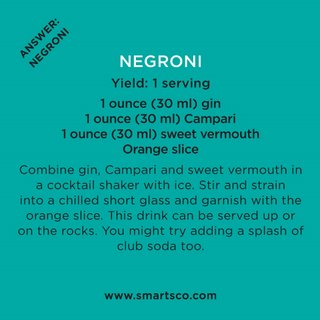
Question: What do you get when you add gin to an Americano?
Answer: Negroni
If you want to make one of these popular drinks at home, here’s how:
1 ounce gin
1 ounce Campari
1 ounce sweet vermouth
Orange slice or twist
Yield: 1 drink
 * Note: In this drink, gin replaces club soda.
Combine gin, Campari, and sweet vermouth in a cocktail shaker with ice. Stir and strain into a chilled short glass such as an old-fashioned. Add a splash of club soda to taste, garnish with the orange slice, and serve. This drink can be served up or on the rocks, although in the U.S., the up version is usually served by default.
All three ingredients can be combined in a pint glass with ice, stirred and strained into a chilled cocktail glass, or served over ice in an old-fashioned glass.
We’re busy planning launch parties in New York and San Francisco later in the year, and if you haven’t already done so, sign up for our newsletter now.
We’ll be sending out information about these parties as we get closer to the date, and the guest list is sure to fill up fast. We’re curious about your favorite drinks and bartenders. If you have drinks, bars, or cool bartenders, you think people need to know about, send a note to cocktail@smartsco.com and we may to blog about them.
 In the meantime, we thought we’d share with you some of the recipes and factoids that will be in CocktailSmarts.
Question: What do you get when you add gin to an Americano?
Answer: Negroni
If you want to make one of these popular drinks at home, here’s how:
1 ounce gin
1 ounce Campari
1 ounce sweet vermouth
Orange slice or twist
Yield: 1 drink
 * Note: In this drink, gin replaces club soda.
Combine gin, Campari, and sweet vermouth in a cocktail shaker with ice. Stir and strain into a chilled short glass such as an old-fashioned. Add a splash of club soda to taste, garnish with the orange slice, and serve. This drink can be served up or on the rocks, although in the U.S., the up version is usually served by default.
All three ingredients can be combined in a pint glass with ice, stirred and strained into a chilled cocktail glass, or served over ice in an old-fashioned glass.
Monday, September 11, 2006
Cars in Carmel  A few weeks ago, I enjoyed a simply decadent day of food, wine, perfume, and cars down in Carmel, one of the most beautiful locals California has to offer. After driving through picturesque farmland on Highway 1 and entering Carmel, a police car raced around us to stop traffic. While normally, one would be pretty bummed to be the first car to be stopped, we quickly realized this was a good thing as we got a front row seat for the “Tour” of the cars participating in this year’s Concours d’Elegance. The Concours is “an international gathering of automotive enthusiasts for ‘a celebration of the automobile’”. In other words, a really cool car competition and exhibition featuring some of the most luxurious classic cars from around the world.
With the fancy cars and wealth enthusiasts in town, all sorts of luxury goods companies take the opportunity to show off their stuff. So when a friend got an invitation to the Land Rover Experience Driving School at Quail Lodge in Carmel, we jumped on it. After checking in at the stunning golf club, we jumped in the Land Rovers with a professional driver who gave us a mini-class in off road driving. Our instructor trains special forces troops for the U.S. military, so he certainly knew what he was doing. I’m typically not a fan of cars (in fact I don’t even have one any more, opting for the bus), but I have to admit, it was pretty fun. I was a bit scared on the back roads, but the Land Rover pretty much does everything for you (including handling the breaking as you go downhill), so I felt quite safe. An exhilarating 1.5 miles / hour!
After our road trip, the event promoters had all sorts of activities for us – including a cooking class and a perfume class featuring L’Artisan Parfumeur, which apparently is the perfume of choice for the stars. My favorite was their “La Chasse Aux Papillons” which, I’m told is the perfume of choice of Kirsten Dunst.
 The best part of the day was the cooking class, from Tony Baker, the exec chef at Montrio Bistro in Monterey. We had a great time, learning how to make fire roasted artichokes with a spicy, Moroccan style charmoula mayonnaise dip. So delicious! Being a native to the SF Bay Area, I grew up on artichokes, but always just had the old standbys – steamed with mayo & lemon. It’s definitely worth experimenting with these yummy thistles. You can now find them year-round, but they are in fact perennials that bloom twice a year—peaking in March & September. There are four types of chokes: Green Globe, Imperial Start, Desert Glob, and the Big Heart. The Green Globes are typically considered the best.
Many argue that it’s difficult to pair a wine with artichokes, but I think a mellow low-acid white wine, such as Riesling would do quite well. Or better yet, I’m thinking a nice amber beer (easy on the hops) would make a great companion. I think I’ll have to do some experimentation on the subject – I'll keep you posted.
Artichokes, Land Rovers & Concours d’Elegance
 A few weeks ago, I enjoyed a simply decadent day of food, wine, perfume, and cars down in Carmel, one of the most beautiful locals California has to offer. After driving through picturesque farmland on Highway 1 and entering Carmel, a police car raced around us to stop traffic. While normally, one would be pretty bummed to be the first car to be stopped, we quickly realized this was a good thing as we got a front row seat for the “Tour” of the cars participating in this year’s Concours d’Elegance. The Concours is “an international gathering of automotive enthusiasts for ‘a celebration of the automobile’”. In other words, a really cool car competition and exhibition featuring some of the most luxurious classic cars from around the world.
With the fancy cars and wealth enthusiasts in town, all sorts of luxury goods companies take the opportunity to show off their stuff. So when a friend got an invitation to the Land Rover Experience Driving School at Quail Lodge in Carmel, we jumped on it. After checking in at the stunning golf club, we jumped in the Land Rovers with a professional driver who gave us a mini-class in off road driving. Our instructor trains special forces troops for the U.S. military, so he certainly knew what he was doing. I’m typically not a fan of cars (in fact I don’t even have one any more, opting for the bus), but I have to admit, it was pretty fun. I was a bit scared on the back roads, but the Land Rover pretty much does everything for you (including handling the breaking as you go downhill), so I felt quite safe. An exhilarating 1.5 miles / hour!
After our road trip, the event promoters had all sorts of activities for us – including a cooking class and a perfume class featuring L’Artisan Parfumeur, which apparently is the perfume of choice for the stars. My favorite was their “La Chasse Aux Papillons” which, I’m told is the perfume of choice of Kirsten Dunst.
 The best part of the day was the cooking class, from Tony Baker, the exec chef at Montrio Bistro in Monterey. We had a great time, learning how to make fire roasted artichokes with a spicy, Moroccan style charmoula mayonnaise dip. So delicious! Being a native to the SF Bay Area, I grew up on artichokes, but always just had the old standbys – steamed with mayo & lemon. It’s definitely worth experimenting with these yummy thistles. You can now find them year-round, but they are in fact perennials that bloom twice a year—peaking in March & September. There are four types of chokes: Green Globe, Imperial Start, Desert Glob, and the Big Heart. The Green Globes are typically considered the best.
Many argue that it’s difficult to pair a wine with artichokes, but I think a mellow low-acid white wine, such as Riesling would do quite well. Or better yet, I’m thinking a nice amber beer (easy on the hops) would make a great companion. I think I’ll have to do some experimentation on the subject – I'll keep you posted.
Saturday, August 26, 2006
Drink Wine. Save Water.
Drink Wine. Save Water.
That’s the name of a recent Wine & Spirits Magazine winetasting event in Seattle where SmartsCo featured a mystery winetasting using WineParty and WineSmarts. The crowd was great..over 250 fun people eager to try great wines from all over, including Portugal, Spain, France, California, Washington, and more. All while raising money to protect the Puget Sound, with Puget Soundkeeper Alliance
If you want to test your WineSmarts as well, here are the questions and answers from the event. Thanks to all the wineries who offered their wines for everyone to taste in our mystery winetasting!
Name another term many California winemakers use for sauvignon blanc.
A) ChardonnayB) White grape
C) Fumé Blanc
D) California Blanc

ANSWER: C) Fumé Blanc
Back in the 1960s, it was difficult to sell Sauvignon Blanc wines, so California winemaking pioneer Robert Mondavi coined the term Fumé Blanc to glamorize this grape and persuade more Americans to drink it. We tasted the Chilean Veramonte Sauvignon Blanc.
Wine #2 Hint
True or False: Chardonnay is often found in white wines from Bordeaux.
ANSWER: FALSE
The white wines of Bordeaux star Sauvignon Blanc. It’s the whites from Burgundy that star Chardonnay. The wine we tasted was from Geyser Peak.

Wine #3 Hint
This wine, described as "full-bodied, tannic, with hints of tobacco and black currant" likely describes:
A) Beaujolais
B) Cabernet Sauvignon
C) Merlot
D) Viognier
ANSWER: B) Cabernet Sauvignon
We tasted Cabernets from both Smoking Loon and Concha Y Toro.
Wine #4 Hint
During Prohibition, what type of wine grape was still widely grown in California?
A) Concord
B) Cabernet Sauvignon
C) Pinot Noir
D) Zinfandel
ANSWER: D) Zinfandel
Zinfandel was often shipped from California to the East Coast where family wine makers (often the mafia) made it into wine. Prohibition laws prohibited mass commercial winemaking, except for use as sacramental wine, medicine, or food flavoring. However, it allowed family, or home, winemaking. We tasted Dancing Bull Zinfandel.
Monday, August 07, 2006
Delicious Outdoor Summer Dinner...lots of grilling
Delicious Outdoor Summer Dinner...lots of grilling 
I was recently lucky enough to be invited by my friends Matt and Ron to a delicious evening of food and wine hosted by Heidi and Chris (Chris is the owner and impresario of the delicious Park Avenue Bar and Grill at 4184 Piedmont in the East Bay. No website yet, but check it out – open 7 days each week. 510-985-0990). Dinner was so yummy that I thought I’d share it with others in case they want to replicate it.I felt like I was in a photo shoot for an elegant gourmet magazine, so I took lots of pictures. The evening started with an informal offering of wine glasses placed on a beautiful green (my favorite color) tray, near a bucket filled with ice and several kinds of wine for the tasting. I had a delicious Markham Sauvignon Blanc and a Domaine De Pellehaut -- a light, citrus-y, summer rosé.

Our hosts set out several cheeses, and I had found a fig-almond spread that was great with the stronger cheeses. Chris shucked several kinds of oysters including Kumamoto – tiny little oysters, that even I, scared of oysters, could try. He prepared them with a squeeze of lemon and champagne vinegar with shallots. Yum!
On to the main course, where Chris grilled asparagus and yellow squash (that cool implement I’m waving around is called a Pig Tail– shaped just like a pig’s tail and perfect for spearing veggies on the grill).
I learned a good grilling tip – that the hot spot of the grill is near the hinges where the grill closes because the walls are higher and the heat reflects there.
Heidi prepared crisp, thin layers of polenta with tomato sauce; iceberg with blue cheese dressing (unlike any blue cheese dressing I have had at a restaurant..this was creamy and smooth and not overpowering). And they grilled fresh wild salmon that their friends Brad and Tony had recently caught. Yum!

One of the wines we were lucky enough to try was Flowers Pinot Noir. And then for dessert (always my fave meal) Matt and Ron grilled fresh peaches and figs and served them warm with vanilla ice cream and caramel sauce.
We ate this with dessert wines, brilliantly suggested by the folks at K and L wines. We had a delicate, slightly sweet rosé sparkling: Cerdon de Bugey from Caveau de St. July, which is a mix of Gamy and Pulsard grapes--slight peach flavors, and, as Ron described it "summer in a glass." We also had a Muscat de Beaumes de Venise, Domaine Bouletin--sweet and yum. Both were very resonable, under $14.00.
MENU

3-kinds of 0ysters
cheeses
Guacamole
Grilled salmon
Polenta and tomato sauce
Iceberg wedges and blue-cheese dressing
Crab legs
Grillesd asparagus and yellow squash
Grilled peaches and figs with vanilla ice cream and caramel sauce
Tuesday, July 25, 2006
Keeping Cool in the City
Tricks for Staying Cool on Sweltering Days Here at the SmartsCo offices in San Francisco, we’re typically clad in jeans and sweaters of some sort. The only difference between summer and winter is whether we wear sandals or boots on our feet. And our favorite item on the lunch menu is a nice bowl of soup from some of our favorite nearby jaunts such as Kate O’Briens or Town Hall. But this summer is quite different ...
Typically we San Franciscans get a nice little chuckle in the summer as we relish in our 55 to 65 degree weather knowing that our neighbors just over the hill are sweating it out in 100 degrees temperatures.
We relish in the fact that if we feel cold in the summer, we can take a short drive, ferry or better yet bike ride to Sam’s Cafe in Tiburon and enjoy the warm weather over tasty Ramoz Fizz and Crab Louie, and then return to our typically foggy home and snuggle up under a nice warm blanket. The best part of living in San Francisco is we can choose whether we’re hot or cool.
But this summer is quite different. It’s hot! Really hot! And most of us don’t have fans, much less air conditioners. And at SmartsCo HQ, we are on the top floor of a building with no AC that just sucks in the hot air. Currently our thermostat reads 94 degrees, and it’s actually cooler than yesterday. So, what are we doing to keep cool?
Ice, Ice Baby
This morning I grabbed a bag of ice for the office. To quote one of our team members “It’s like Christmas morning. The best gift ever.” Who knew a little ice could make such a difference. Not only are our coffees and waters iced, we can drench ourselves with the ice.
Don’t Pass the Buck
While typically a Peet’s girl myself, unfortunately, their shops typically aren’t so great for hanging out. But Starbucks generally has great seating, and they’re air conditioned. We’ve been sucking down their herbal berry ice tea and even bringing our laptops to do some work.
Cold Soup
While our hot soup preference isn’t too appetizing these days, cold soup can really hit the spot. While gazpacho is the obvious choice, I’ve been indulging in some really yummy ones lately, including: cold sorrel soup (delish), cold cucumber soup, and cold asparagus soup.
Creative Salads
Green salads don’t have to be boring, especially with all the great wonderful fruits and veggies that are in season right now. Last week I made a delicious salad with: sugar snap peas, jicama, fresh corn (cut it off the cob uncooked), tomatoes, red peppers, and some black beans. Toss on a spicy vinaigrette and it’s fun time. Or throw in strawberries, melons or even peaches to a green salad and it’s really refreshing.
H20 Melon
I could just eat watermelon all day long. Not only super refreshing, it’s actually quite low in calories. Mmmmmmmmmmmmm.
Pass the Prosecco Please – or other light wine
When all else fails, have some wine. It certainly seems like sundown comes quicker. We typically keep the office fridge stocked with the very reasonably priced Vinho Verdhe from Broadbent Selections. It’s slightly effervescent and low in alcohol so we can continue to function at full capacity. Or when we really need some bubbles to wake us up, we’ll pop open a bottle of Italian Prosecco – which are typically bright and cheerful, and good bargains to boot.
That’s all I can think of to stay cool on this blistering hot day. If anyone else has brilliant ideas, we’d love to hear them. I’m proud to announce that last month I became car-less, which is my attempt to do my small part to stop contributing to global warming. So it’s all public transportation and in the rare occurrences that I need a car, I check out one from our friends at ZipCar. Not only am I saving $100s / month, I never have to worry about high gas prices (gas is included with ZipCar), insurance, and I don't have to worry what day street cleaning is. Why I didn’t do this sooner is the biggest mystery.
Typically we San Franciscans get a nice little chuckle in the summer as we relish in our 55 to 65 degree weather knowing that our neighbors just over the hill are sweating it out in 100 degrees temperatures.
We relish in the fact that if we feel cold in the summer, we can take a short drive, ferry or better yet bike ride to Sam’s Cafe in Tiburon and enjoy the warm weather over tasty Ramoz Fizz and Crab Louie, and then return to our typically foggy home and snuggle up under a nice warm blanket. The best part of living in San Francisco is we can choose whether we’re hot or cool.
But this summer is quite different. It’s hot! Really hot! And most of us don’t have fans, much less air conditioners. And at SmartsCo HQ, we are on the top floor of a building with no AC that just sucks in the hot air. Currently our thermostat reads 94 degrees, and it’s actually cooler than yesterday. So, what are we doing to keep cool?
Ice, Ice Baby
This morning I grabbed a bag of ice for the office. To quote one of our team members “It’s like Christmas morning. The best gift ever.” Who knew a little ice could make such a difference. Not only are our coffees and waters iced, we can drench ourselves with the ice.
Don’t Pass the Buck
While typically a Peet’s girl myself, unfortunately, their shops typically aren’t so great for hanging out. But Starbucks generally has great seating, and they’re air conditioned. We’ve been sucking down their herbal berry ice tea and even bringing our laptops to do some work.
Cold Soup
While our hot soup preference isn’t too appetizing these days, cold soup can really hit the spot. While gazpacho is the obvious choice, I’ve been indulging in some really yummy ones lately, including: cold sorrel soup (delish), cold cucumber soup, and cold asparagus soup.
Creative Salads
Green salads don’t have to be boring, especially with all the great wonderful fruits and veggies that are in season right now. Last week I made a delicious salad with: sugar snap peas, jicama, fresh corn (cut it off the cob uncooked), tomatoes, red peppers, and some black beans. Toss on a spicy vinaigrette and it’s fun time. Or throw in strawberries, melons or even peaches to a green salad and it’s really refreshing.
H20 Melon
I could just eat watermelon all day long. Not only super refreshing, it’s actually quite low in calories. Mmmmmmmmmmmmm.
Pass the Prosecco Please – or other light wine
When all else fails, have some wine. It certainly seems like sundown comes quicker. We typically keep the office fridge stocked with the very reasonably priced Vinho Verdhe from Broadbent Selections. It’s slightly effervescent and low in alcohol so we can continue to function at full capacity. Or when we really need some bubbles to wake us up, we’ll pop open a bottle of Italian Prosecco – which are typically bright and cheerful, and good bargains to boot.
That’s all I can think of to stay cool on this blistering hot day. If anyone else has brilliant ideas, we’d love to hear them. I’m proud to announce that last month I became car-less, which is my attempt to do my small part to stop contributing to global warming. So it’s all public transportation and in the rare occurrences that I need a car, I check out one from our friends at ZipCar. Not only am I saving $100s / month, I never have to worry about high gas prices (gas is included with ZipCar), insurance, and I don't have to worry what day street cleaning is. Why I didn’t do this sooner is the biggest mystery.
Monday, July 03, 2006
Summer and Beer - the perfect pairing
Summer and Beer - the perfect pairing
 I'm going to try not to sound like a bad beer commercial here, but there is something wonderful about a beer on a hot summer day. And since I'm a SmartsCo girl, I can't just have a beer, I need to gather some friends around to compare a variety of beers and have a beer tasting. Until we developed BeerSmarts, I didn't know the difference between a lager and an ale, or about the huge variety of beers available.
In BeerSmarts, our writer Joe Cummins, and editor Garrett Oliver, brewmaster of the Brooklyn Brewery, shared a great description of the difference between lager and ale, and an overview of ales. So chill your glass and read on... (and if you want to check out his tips for throwing your own beer tasting party, visit our party tips page.
Ale and Lager--What's the difference?
There are two main species of yeast for fermenting beer, and they make the two types of beer we have today: ale and lager. Within these two species are thousands of strains.
ALE has been brewed since ancient times and was mostly unhopped until the 15th century. Ale is fermented at warm temperatures where the yeast rises to the top. Such “top-fermenting” yeast works very quickly, which is why ale is generally aged for only a few weeks at most. It tends to be fruity in flavor.
LAGER is the type of beer most casual American drinkers are familiar with. Lagers are bottom fermenting, which means that the yeast ferments at colder temperatures, and sinks to the bottom of the vat. Traditionally the beer is then aged for months (however mass market lagers are usually only aged for a couple of weeks). Lager tends to be smooth and subtle in flavor, and today accounts for most of the beer consumed in the world.

A Spotlight on lagers
Pilsner
Pilsner originated in the 19th century in what is now the Czech Republic. This dry, superbly golden, carbonated beer took an ale-weary world by storm and today is still the most popular beer around. Beers such as Budweiser and Miller are based on the Pilsner style although they use some different ingredients and are less flavorful than the original.
Bock / Doppelbock
Bock is a strong and malty beer that originated in the German city of Einbeck. It was originally brewed late in the harvest season, stored all winter and tapped in the spring. A stronger bock beer is known as doppelbock.
Oktoberfest (Märzen)
Hearty and full of malt flavor, these beers are traditionally brewed in the sp ring (märzen means March in German) to last through the summer into the fall. A nice accompaniment to an Oktoberfest celebration.
Malt Liquor
Malt liquors usually have added rice, corn or refined sugars (as do almost all mass-market beers), although so

Helles
Helles means “bright” in German, and these pale, golden beers are easy-drinking and slightly less bitter than their neighboring Czech pilsners. Helles is the most popular beer style in Bavaria.
Dunkel
Dunkels (meaning “dark” in German), are smooth reddish-brown beers made with gently toasted barley malts, creating soft caramel, nutty, and coffee flavors.
Standard American Lager
These tend to be quite bland, light-bodied, pale in color, with lots of fizz. The big-name U.S. brands follow this style.
Wednesday, June 21, 2006
Paris food and wine tips from local expert! (Sneak preview of ParisSmarts)
It's hot in our little SmartsCo office, so I'm imagining I'm drinking a crisp, cool glass of rosé, while sitting in a little cafe in Paris. In you happen to be lucky enough to be going there soon, we've compiled off-the-beaten-path food and drink suggestions from our newest game, ParisSmarts, edited by Gourmet Magazine's European correspondent Alec Lobrano. He shared some of his favorites, and if you like these...pick up a copy of our new ParisSmarts, for even more suggestions and discoveries in the City of Light.
Alcoholic Sorbet
BERTHILLON
Ty their champagne-infused sorbet. Mmmm … it's a cocktail in a cone.
31 rue St. Louis en l'Ile ,4th
01.43.54.31.61
Crème Brûlée
CAFÉ DU MARCHÉ
Crème Brûlée is elevated to an art form here in the heart of the Rue Cler neighborhood.
38 rue Cler, 7th
01.47.05.51.27
French-Asian Fusion
LE RÉFECTOIRE
This campy take on French school cafeterias (réfectoires in French) features furniture that may take you back to your days in grade school, except with a trendy flair and great food.
80 boulevard Richard Lenoir, 11th
01.48.06.74.85
Macaroons
LADUREE
Traditionally rich and unbelievably light, the macaroons here are one of Paris's most decadent desserts. They are crisp on the outside, soft on the inside, and come in an amazing range of flavors including chocolate, raspberry, lime basil and blackcurrant violet. Several in Paris. Try the elegant tearoom at:
16 rue Royale, 8th
01.42.60.21.79
Organic Vegetables
MARCHÉ BIOLOGIQUE
The place-to-be on Sunday mornings for any lover of expertly farmed, all-natural produce.
Boulevard Raspail, 7th
Stinky Cheese
BARTHELEMY
Local and international fromage-philes shop at this Paris landmark. When it's in season, the Vacherin here is the best in the world.
51 rue de Grenelle, 7th
01.45.48.56.75
'60s Bar
POLLY MAGOO
This casual cult bar opened in 1967 and hasn't aged since. Hear that? It's the Doors, probably on vinyl …
11 rue St. Jacques, 5th
01.46.33.33.64
African Bar
IMPALA LOUNGE
The Impala Lounge is more than an African theme bar -- it's also one of the hottest spots in the city, popular for its Afro vibe and original cocktail concoctions. Don't be surprised to see ostrich steaks on the menu.
2 rue de Berri, 8th
01.43.59.12.66
Alcoholic Sorbet
BERTHILLON
Ty their champagne-infused sorbet. Mmmm … it's a cocktail in a cone.
31 rue St. Louis en l'Ile ,4th
01.43.54.31.61
Crème Brûlée
CAFÉ DU MARCHÉ
Crème Brûlée is elevated to an art form here in the heart of the Rue Cler neighborhood.
38 rue Cler, 7th
01.47.05.51.27
French-Asian Fusion
LE RÉFECTOIRE
This campy take on French school cafeterias (réfectoires in French) features furniture that may take you back to your days in grade school, except with a trendy flair and great food.
80 boulevard Richard Lenoir, 11th
01.48.06.74.85
Macaroons
LADUREE
Traditionally rich and unbelievably light, the macaroons here are one of Paris's most decadent desserts. They are crisp on the outside, soft on the inside, and come in an amazing range of flavors including chocolate, raspberry, lime basil and blackcurrant violet. Several in Paris. Try the elegant tearoom at:
16 rue Royale, 8th
01.42.60.21.79
Organic Vegetables
MARCHÉ BIOLOGIQUE
The place-to-be on Sunday mornings for any lover of expertly farmed, all-natural produce.
Boulevard Raspail, 7th
Stinky Cheese
BARTHELEMY
Local and international fromage-philes shop at this Paris landmark. When it's in season, the Vacherin here is the best in the world.
51 rue de Grenelle, 7th
01.45.48.56.75
'60s Bar
POLLY MAGOO
This casual cult bar opened in 1967 and hasn't aged since. Hear that? It's the Doors, probably on vinyl …
11 rue St. Jacques, 5th
01.46.33.33.64
African Bar
IMPALA LOUNGE
The Impala Lounge is more than an African theme bar -- it's also one of the hottest spots in the city, popular for its Afro vibe and original cocktail concoctions. Don't be surprised to see ostrich steaks on the menu.
2 rue de Berri, 8th
01.43.59.12.66
Monday, June 12, 2006
Traveling to Spain in my glass
Sometimes there’s no time for an actual real-world trip, and a winetasting works quite nicely as a virtual one. Last week Julie and I went to a Spanish tasting (never been to Spain. would like to go), and discovered all sorts of wonderful wines We were lucky to find out about this event thanks to our friends Meredith and Jane at a Chow Magazine.
The event was put on by the folks from WinesFromSpain, and it was delightful. I left refreshed, educated, and no jet lag. Many big tastings feel a little crazed with everyone drinking and scouring the room for some little bit of cheese, and they're not always that much fun. This, however, was great–in a beautiful light-filled space in Yerba Buena Gardens–a modern art complex in SF, with lots of Spanish wineries showing off their wines. It was all very relaxed and social. AND there was excellent tapas, everywhere, which makes everyone happier.
Now for the wines. I enjoyed several of them and it was hard to spit out some of them (I’m getting better…not splashing myself or others quite so much) and now I want SmartsCo to create a WinePassport: Spain, like our other WinePassports. because there’s so much to learn and discover. If you think that would be a good idea, send us an email at info@smartsco.com with what you’d like to learn about Spanish wines.
From Bodegas Martín Códax
Martín Códax Albariño 2005, D.O. Rías Baixas. Albariño is a white grape varietal that tends to create wines with a good amount of fruit and a lot of acidity to balance it out. And the region Rías Baixas in the northwest corner of Spain is known for its Albariño. This wine was lovely – I want some for my home right now. It has tastes of green apple, pears, and a great amount of acid to make it stand up to salty seafood.
Burgáns Albariño 2005, Bodegas Martín Códax. This is a more widely available wine – available in 42 states according to the woman pouring the wine, but to me, it’s less interesting and more like an American Chardonnay – more round and fruity and sweet. People who like those wines might really enjoy this.
Cuatros Pasos 2004, Bodegas Martín Códax, D.O. Bierzo. OK – I had to taste this red wine because it has three bright red bear paws on the label, and it’s named Four paws because the winemakers found tracks in their vineyard. It’s made from a grape I hadn’t heard of before, Mencia. It’s a very hard grape to work with. And it is waaaay unusual. It smells really smoky, which I was told is one of the characteristics of the grape. And it tastes like smoked wood. Almost like a campfire with some beef jerky (which, I have to admit, I have never eaten but fer sher know the smell well).
Other favorites were from Codorníu, which is the largest bubbly producer in Spain (I've been told they have a great visiting tasting room), Their Cuvée Raventós Brut, D.O. Cava was amazing. Made mostly from chardonnay it was, as the experts say, YUM. Tastes of pecans, yeasty, vanilla, dry, with a long finish. I tried several of their wines and was similarly really into them
Vinña Pomal Crianza, 2000 Bilbaínas, DOCa Rioja. This is made from the Tempranillo grape and is amazing. The aromas are of cooked dark fruites like berries and cherries and a little bit of cedar. Just the aromas feel rich. And then at the first sip it tasted just like the aroma – you could eat it with a fork. Wow.
The event was put on by the folks from WinesFromSpain, and it was delightful. I left refreshed, educated, and no jet lag. Many big tastings feel a little crazed with everyone drinking and scouring the room for some little bit of cheese, and they're not always that much fun. This, however, was great–in a beautiful light-filled space in Yerba Buena Gardens–a modern art complex in SF, with lots of Spanish wineries showing off their wines. It was all very relaxed and social. AND there was excellent tapas, everywhere, which makes everyone happier.
Now for the wines. I enjoyed several of them and it was hard to spit out some of them (I’m getting better…not splashing myself or others quite so much) and now I want SmartsCo to create a WinePassport: Spain, like our other WinePassports. because there’s so much to learn and discover. If you think that would be a good idea, send us an email at info@smartsco.com with what you’d like to learn about Spanish wines.
From Bodegas Martín Códax
Martín Códax Albariño 2005, D.O. Rías Baixas. Albariño is a white grape varietal that tends to create wines with a good amount of fruit and a lot of acidity to balance it out. And the region Rías Baixas in the northwest corner of Spain is known for its Albariño. This wine was lovely – I want some for my home right now. It has tastes of green apple, pears, and a great amount of acid to make it stand up to salty seafood.
Burgáns Albariño 2005, Bodegas Martín Códax. This is a more widely available wine – available in 42 states according to the woman pouring the wine, but to me, it’s less interesting and more like an American Chardonnay – more round and fruity and sweet. People who like those wines might really enjoy this.
Cuatros Pasos 2004, Bodegas Martín Códax, D.O. Bierzo. OK – I had to taste this red wine because it has three bright red bear paws on the label, and it’s named Four paws because the winemakers found tracks in their vineyard. It’s made from a grape I hadn’t heard of before, Mencia. It’s a very hard grape to work with. And it is waaaay unusual. It smells really smoky, which I was told is one of the characteristics of the grape. And it tastes like smoked wood. Almost like a campfire with some beef jerky (which, I have to admit, I have never eaten but fer sher know the smell well).
Other favorites were from Codorníu, which is the largest bubbly producer in Spain (I've been told they have a great visiting tasting room), Their Cuvée Raventós Brut, D.O. Cava was amazing. Made mostly from chardonnay it was, as the experts say, YUM. Tastes of pecans, yeasty, vanilla, dry, with a long finish. I tried several of their wines and was similarly really into them
Vinña Pomal Crianza, 2000 Bilbaínas, DOCa Rioja. This is made from the Tempranillo grape and is amazing. The aromas are of cooked dark fruites like berries and cherries and a little bit of cedar. Just the aromas feel rich. And then at the first sip it tasted just like the aroma – you could eat it with a fork. Wow.
WineSmarts editor celebrates new book
I went to a winetasting a few weeks ago celebrating WineSmarts editor and friend Ray Johnson’s new book, The Good Life Guide to Enjoying Wine. There was a nice crowd of about 30 people.
It was held at the Viansa wine bar in San Francisco, and in addition to tasting their Italian-inspired wines, we also got to taste some oldies but goodies that Ray generously shared with us.
Ray gave some great tips on wine and food pairing:
* Don't spend so much energy chasing the perfect wine and food match. Things change depending on what you feel like, who you’re with, etc.
* Avoid the trap of picking a single wine for a whole table of people—everyone has different tastes, so find out what kinds of flavors they like and order a few bottles.
* Pairing wine with sweet foods: try a wine sweeter than the food. For fruit, crèmes and pastries, try a sweet white. With black fruits or chocolate, try a red. And, Ray suggests, don’t forget Malmsy Madeira (Madeira is made on the island of Madeira just off of Portugal, and Malmsey is a grape that makes one of the richer, sweeter madeiras)--it’s especially delicious with Roquefort.
* Young trophy wines – when you have an elegant bottle that’s still young, pair it with a dish with lots of protein and salt to work with the heavy tannins.
*Old gems – taste an older wine before your guests do—sometimes they fade with time. You might want to serve it with something very delicate, or just enjoy it alone.
Here are the wines we tasted:
From Viansa,
I had a lovely, light, dry white, with some mineraly taste and a long finish. Tocai Friulano that would make a great summer white.
Tocai is a grape made famous in Italy and has recently been the subject of international disputes, because the name is so similar to the Hungarian Tokaji or Tokay, that makes a very different, sweet wine. Here’s more information on the Tokay dispute.
From Ray’s collection:
1) Sori’ Paitin Dolcetto d’Alba DOC, 2003
2) Poliziano, Vino Nobile Di Montepulciano, DOCG, 1999
100% Sangiovese
3) Silvio Grasso, Barolo DOCG Pì Vigne, 1998
YUM. This is a wine made from the Nebbiolo grape which had an aroma of stewed black fruits. It had quite a bit of tannin but would have been great with food. Ray noted that “while Nebbiolo is typically hard as nails when young,” they can age beautifully.
It was held at the Viansa wine bar in San Francisco, and in addition to tasting their Italian-inspired wines, we also got to taste some oldies but goodies that Ray generously shared with us.
Ray gave some great tips on wine and food pairing:
* Don't spend so much energy chasing the perfect wine and food match. Things change depending on what you feel like, who you’re with, etc.
* Avoid the trap of picking a single wine for a whole table of people—everyone has different tastes, so find out what kinds of flavors they like and order a few bottles.
* Pairing wine with sweet foods: try a wine sweeter than the food. For fruit, crèmes and pastries, try a sweet white. With black fruits or chocolate, try a red. And, Ray suggests, don’t forget Malmsy Madeira (Madeira is made on the island of Madeira just off of Portugal, and Malmsey is a grape that makes one of the richer, sweeter madeiras)--it’s especially delicious with Roquefort.
* Young trophy wines – when you have an elegant bottle that’s still young, pair it with a dish with lots of protein and salt to work with the heavy tannins.
*Old gems – taste an older wine before your guests do—sometimes they fade with time. You might want to serve it with something very delicate, or just enjoy it alone.
Here are the wines we tasted:
From Viansa,
I had a lovely, light, dry white, with some mineraly taste and a long finish. Tocai Friulano that would make a great summer white.
Tocai is a grape made famous in Italy and has recently been the subject of international disputes, because the name is so similar to the Hungarian Tokaji or Tokay, that makes a very different, sweet wine. Here’s more information on the Tokay dispute.
From Ray’s collection:
1) Sori’ Paitin Dolcetto d’Alba DOC, 2003
2) Poliziano, Vino Nobile Di Montepulciano, DOCG, 1999
100% Sangiovese
3) Silvio Grasso, Barolo DOCG Pì Vigne, 1998
YUM. This is a wine made from the Nebbiolo grape which had an aroma of stewed black fruits. It had quite a bit of tannin but would have been great with food. Ray noted that “while Nebbiolo is typically hard as nails when young,” they can age beautifully.
Subscribe to:
Posts (Atom)
